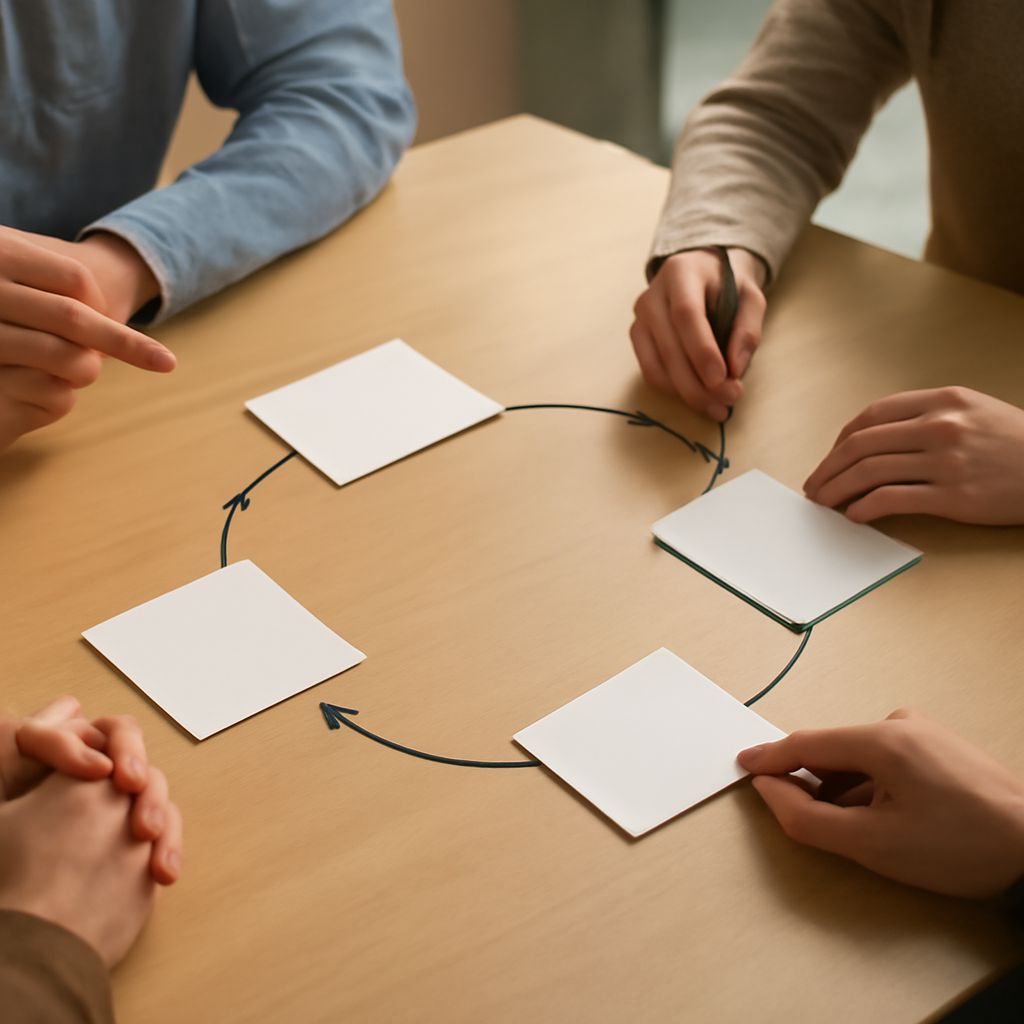
Organizational methods help a team turn a vague issue into visible work, clear decisions, and owned actions. The goal is not individual tidiness. It is a shared system for organizing information, roles, and choices during team problem solving.
Use the same few methods each time: agree on the outcome, show the work, assign decision rights, record what was decided, and review whether actions worked. These habits build a team mentality based on useful behavior rather than a slogan about teamwork.
What a Team Mentality Looks Like in Practice
A productive team mentality starts with a shared outcome. People understand what must improve, who benefits, and what a successful result will look like. They support one another without taking over another person’s responsibility.
The team also practices candor. Members can state that evidence is weak, a plan may fail, or a decision creates a risk. Candor works best when it focuses on the problem and the work, not on personal blame.
Learning means treating results as information. If a test fails, the team asks what it revealed and what should change. Accountability then connects learning to action: each commitment has an owner, a due date, and a clear success measure.
Facilitation protects this mentality. Use a short round for each person before open discussion, invite written ideas from quieter members, and ask for dissent before confirming a decision. These steps reduce dominance and prevent early agreement from hiding important concerns.
Organizational Methods That Make Work Visible
Start each meeting with an agenda that names the outcome, the decision needed, the evidence to review, and the time available. Put information items in a separate section so they do not consume time meant for solving or deciding.
Use a simple visual workboard with columns such as questions, evidence, options, testing, and done. Each card should state one item, its owner, and its next move. Limit the number of items in progress so the team can see stalled work instead of hiding it in a long task list.
Clarify roles before discussion begins. A useful set is:
- Facilitator: manages the process, time, and participation.
- Problem owner: keeps the issue defined and coordinates the work.
- Evidence lead: gathers and checks relevant information.
- Decision maker: makes the call when the group has examined the options.
- Recorder: captures the decision, reasons, and actions.
One person can hold more than one role, but the decision maker should never be unclear. Role clarity prevents discussion from ending with shared concern but no authority to act.
Keep a decision log with the date, decision, alternatives considered, evidence used, assumptions, owner, and review date. This prevents the team from reopening settled questions simply because people remember the discussion differently.
A Team Problem Solving Process
Use this order for most issues. Move back one step when new evidence changes the situation, but do not skip steps to reach a quick answer.
- Write the problem statement. Describe the gap between the current and desired result. Include who is affected, where the issue occurs, and when it began. Avoid naming a solution as the problem.
- Gather evidence. Separate observed facts from opinions. Check examples, measures, customer feedback, process records, and relevant constraints. Mark unknowns instead of filling them with guesses.
- Explore causes. Ask what conditions produce the gap. Compare possible causes against the evidence, and distinguish a root condition from a visible symptom.
- Generate options. Have people write ideas silently before discussion, then group similar options. This limits the influence of the first speaker and gives less vocal members space to contribute.
- Choose a test. Select the smallest safe experiment that can distinguish between promising options. Define the change, duration, measure, owner, and stop condition.
- Make the decision. The decision maker states the choice, reasons, risks, and any conditions. Invite a final objection before closing, but do not treat silence as agreement without checking understanding.
- Review the result. Compare the outcome with the agreed measure. Keep, adapt, or stop the approach, and record what the team learned.
Keep Decisions and Actions from Getting Lost
End every meeting by reading back the decision and the action list. Each action needs one named owner, one due date, one expected result, and a location for its supporting information. “The team will investigate” is not an assigned action.
Use a brief action review at the start of the next meeting. Owners report done, blocked, or not started, with the next step for anything incomplete. Move blocked work to the visible board and assign the person who can remove the obstacle.
A method is working when people can find the latest evidence, explain why a decision was made, and see what happens next. If discussions repeat, actions have no owners, or only the most confident members shape the answer, change the facilitation or the information system before asking the team for more effort.